The Women of the Night: Southern Italian Healers, Witches, and the Silenced Lineages

Reclaiming the Mystique and the Lesser Known Stories
By Danielle Marie Fusco

Original photo by Rob Klein. Photo of myself dancing my recent repertory work called Night Battle
There is a silence in Southern Italian history.
It lives between the official records and the whispered stories.
Between Church archives and kitchen rituals.
Between accusation and reverence.
It is the silence surrounding the women.
The healers.
The midwives.
The herbalists.
The prayer-keepers.
The artists
The free spirits
The women labeled streghe.
The women who worked at night.
I am an Italian-American artist rooted in Southern Italian lineage. My work, through dance, ritual, education, and interdisciplinary performance, seeks to give voice to women whose stories were marginalized, distorted, or erased. Not to romanticize them. Not to weaponize history. But to reclaim complexity.
Because the truth is layered.
Who Were the Southern Italian “Witches”?
The word strega in Italian historically referred to a witch, but its meaning shifts depending on region, era, and social context.
In early modern Italy (15th–17th centuries), witchcraft accusations did occur, particularly during periods influenced by broader European witch hunts.
It was often localized and entangled with:
• Social tensions
• Gendered power structures
• Rural superstition
• Church orthodoxy
• Community fear
Many women accused of witchcraft were healers, midwives, or socially marginal individuals. Others were simply vulnerable. At the same time, Southern Italy preserved a deep and complex folk tradition that existed alongside Catholicism and was not always in opposition to it.
Folk Catholicism and Women’s Ritual Authority
Southern Italian spirituality has long blended:
• Catholic devotion
• Pre-Christian Mediterranean symbolism
• Agricultural rites
• Seasonal festivals
• Protective magic
• Ancestral veneration
Anthropologists such as Ernesto de Martino documented the phenomenon of tarantismo in Puglia in the mid-20th century, where women, believed to be bitten by a mythical spider, entered altered states of dance and music as communal healing rituals.
De Martino’s research in The Land of Remorse (1961) framed tarantismo as a socio-cultural response to emotional and economic distress, especially among women in rural societies. Whether interpreted as psychological, ritualistic, or spiritual, one fact remains:
Women were central to the ritual space.
They were not passive recipients.
They were participants in embodied catharsis.
Similarly, in rural Southern Italy, women preserved:
• Malocchio (evil eye) removal prayers
• Herbal remedies
• Protective charms
• Birth and death rituals
• Seasonal land-based rites
These practices were often transmitted orally, matrilineally, and privately. Not as organized secret societies in the formal sense...but as networks of knowledge, discretion, and trust.
“Le Donne della Notte” (The Women of the Night) — Myth, Memory, and Meaning
There are folkloric references throughout Italian history to women associated with the night. Figures such as the janare of Benevento, said to gather beneath walnut trees, or the Sicilian Donne di Fuora, mysterious “women from outside” believed to move between homes and unseen realms under the cover of darkness. In Calabria and other Southern regions, women known as macare or fattucchiere were remembered as healers, ritual workers, and keepers of practical magic—figures who existed within the community, yet slightly outside of it.
Some were feared. Some were sought out. Most were both.
Carlo Ginzburg’s research into the benandanti of Friuli (in Northern Italy) revealed 16th-century individuals—both men and women—who described spiritual night journeys in which they battled forces threatening the harvest.
While the benandanti were not exclusively female nor Southern, their accounts suggest something wider: that across Italy, there existed belief systems in which ordinary people, often from rural communities, moved between visible and invisible worlds.
In Southern Italy, these patterns appear less in formal records and more in fragments such as folklore, testimony, prayer, and gesture.
But there is something that the tales and testimonies share.
A pattern.
A presence.
A continuity.
Women who worked quietly. Sometimes at night. Sometimes in kitchens, fields, and thresholds. Sometimes in altered states of prayer, trance, or embodied ritual.
However, culturally, the idea of women working at night carries layered meaning:
Night as secrecy
Night as protection
Night as feminine power
Night as refuge from surveillance
The mystique exists because women’s knowledge often had to survive quietly.
And silence can create allure.
The Inquisition and Patriarchal Structures
The Italian peninsula was deeply influenced by the Roman Catholic Church and its institutions, including the Inquisition. While Italy’s witch trials were often less extreme than in Northern Europe, Church courts did prosecute heresy, superstition, and unorthodox practices.
When we look at the Inquisition, we aren't just looking at court records; we’re looking at the moment the 'official' world tried to reach into the kitchen and the birthing room. It wasn't just an attack on 'witches'...it was the slow, deliberate replacement of the neighborhood midwife's hands with a male-dominated medical system that didn't know the songs she sang or the herbs she gathered. It was a takeover of spiritual authority that tried to tell us our folk remedies were 'unorthodox' rather than essential.
This transition reflects a broader European pattern:
• Informal female healing roles were gradually delegitimized.
• Medical authority professionalized under male structures.
• Spiritual authority centralized under Church hierarchy.
Some would argue that this was not solely an “attack on women” as a singular event, but part of systemic shifts in power. And yet, women’s folk practices survived.
Quietly.
Persistently.
Adaptively.
Southern Italy: Diversity Within Diversity
To be of Southern Italian lineage is to be a living crossroads. We are a beautiful hybrid .... part Greek, part Arab, part Norman, and deeply rooted in indigenous Italic tribes. When I dance, I’m not just performing one culture; I’m moving through layers of a Mediterranean history that refused to be simplified. In the U.S., we’re often boxed into a 1920s Ellis Island stereotype, but my work is about reaching further back to the agricultural mysticism and the land-based rituals that our ancestors carried in their bones long before they reached a pier in New York."
In the United States, Italian American narratives are often simplified:
• Early 1900s Ellis Island immigration
• Catholic parish life
• Industrial labor
• Organized crime stereotypes
Where are the healers?
The land-based rituals?
The agricultural mysticism?
The pre-modern feminine spiritual authority?
The complex Mediterranean syncretism?
I would love to see more of those stories in film, theater, dance, and which is why I created my platform American Strega. (Instagram @American.Strega and my repertory company Terra Nuova Company @terranuovacompany)
The Artist as Reclaimer
As a multidisciplinary artist and the American Strega, my work does not claim to reconstruct a lost secret order with academic certainty.
It does something else.
It asks:
What happens when we re-center women’s voices?
What happens when we embody ancestral gesture?
What happens when dance becomes archive?
What happens when we allow mystique without fabrication?
Art is not court documentation. It is interpretive reclamation.
Through choreography, ritual-informed performance, and interdisciplinary creation, I seek to give voice to:
• The unnamed midwife
• The woman accused of superstition
• The herbalist dismissed as uneducated
• The ecstatic dancer of tarantismo
• The matriarch whispering malocchio prayers in a kitchen
Not as fantasy archetypes, but as historical presences.
Why This Matters in Contemporary Media
In the U.S., the Italian narrative is often reduced to Ellis Island, parish life, and mob tropes. But where are our healers? Where is the agricultural mysticism and the pre-modern feminine authority? Where is the complex Mediterranean syncretism that our grandmothers carried?
We deserve:
• Films exploring rural ritual traditions.
• Stage works centered on female folk healers.
• (More) Documentaries on women’s lived experience.
• Choreographic works embodying land-based ritual.
• Nuanced historical dramas rooted in accurate research.
Ancestral reclamation is not anti-modern. It is culturally literate.
Interpretation and Responsibility
Reclaiming these stories is a heavy, sacred responsibility. I’m not interested in creating a fantasy or 'cosplaying' as a victim of history. It’s about balance: honoring the silence of the archives without filling the gaps with lies. I want to celebrate the folk healer without ignoring the very real danger she lived in. For me, ancestral reclamation isn't a trend...it's about being culturally literate and making sure that when we say 'HERStory,' we aren't just swapping one caricature for another.
A Living Lineage
Southern Italian women were not passive figures in history.
They cultivated land.
They preserved food systems.
They mediated family disputes.
They tended the sick.
They birthed children.
They prayed.
They sang.
They danced.
They whispered remedies.
They carried cosmologies in gesture.
Some were persecuted. Some were not. Most were simply living complex lives within layered systems of faith, survival, and gendered expectation.
The mystique exists because their knowledge survived between worlds.
And as an Italian-American woman artist, I feel called to explore that space between documented history and embodied memory.
Not to rewrite the past.
But to expand who is allowed to be seen.
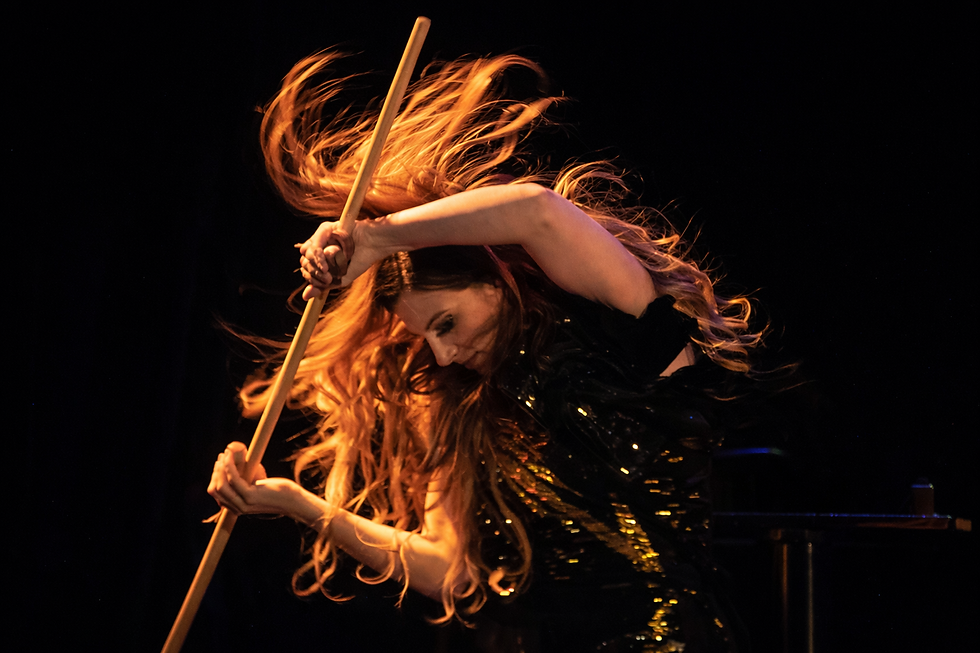
Photo of myself taken by Rob Klein for Festa Della Donna at the Triad Theatre 2026
Thank you so much for taking the time to read my blog. This space is a platform where I share my perspectives, experiences, and reflections as an artist, healer and educator.
If you would like to continue the conversation and connect with a like-minded community, I invite you to follow me on social media. I also host a Facebook group where we explore topics related to Italian dance, culture, creativity, healing practices, and artistic exchange.
You can also explore some of my ongoing offerings, including Italian dance workshops, healing events, performances, and other interdisciplinary experiences.
Check out the new Calabria retreat! Sign up for more information. June 27-July 3
FACEBOOK GROUP: CLICK HERE
DANIELLE'S INSTAGRAM: CLICK HERE TO FOLLOW DANIELLE THE DANCER
ITALIAN ARTS FESTIVAL INSTAGRAM: CLICK HERE TO FOLLOW ITALIAN FOLK ARTS EVENTS
AMERICAN STREGA INSTAGRAM: CLICK HERE FOR ITALIAN MYSTICISM
On May 16th, my company, Italian Arts Festival: The Spirit of Italy, will be participating in the NYC Dance Parade. If you would like to join us and celebrate Italian culture through dance, please fill out the Google form below.
I would love to have you be part of the experience.
Sources & Inspiration
Ernesto de Martino, South and Magic (1959; trans. 2015)
Ernesto de Martino, The Land of Remorse (1961)
Carlo Ginzburg, The Night Battles (1983)
Carlo Ginzburg, Ecstasies (1991)
David Gentilcore, Healers and Healing in Early Modern Italy (1998)
Marina Montesano, Classical Culture and Witchcraft in Medieval and Renaissance Italy (2018)
This piece is also informed by oral tradition, lived experience, and ongoing cultural research.


Comments